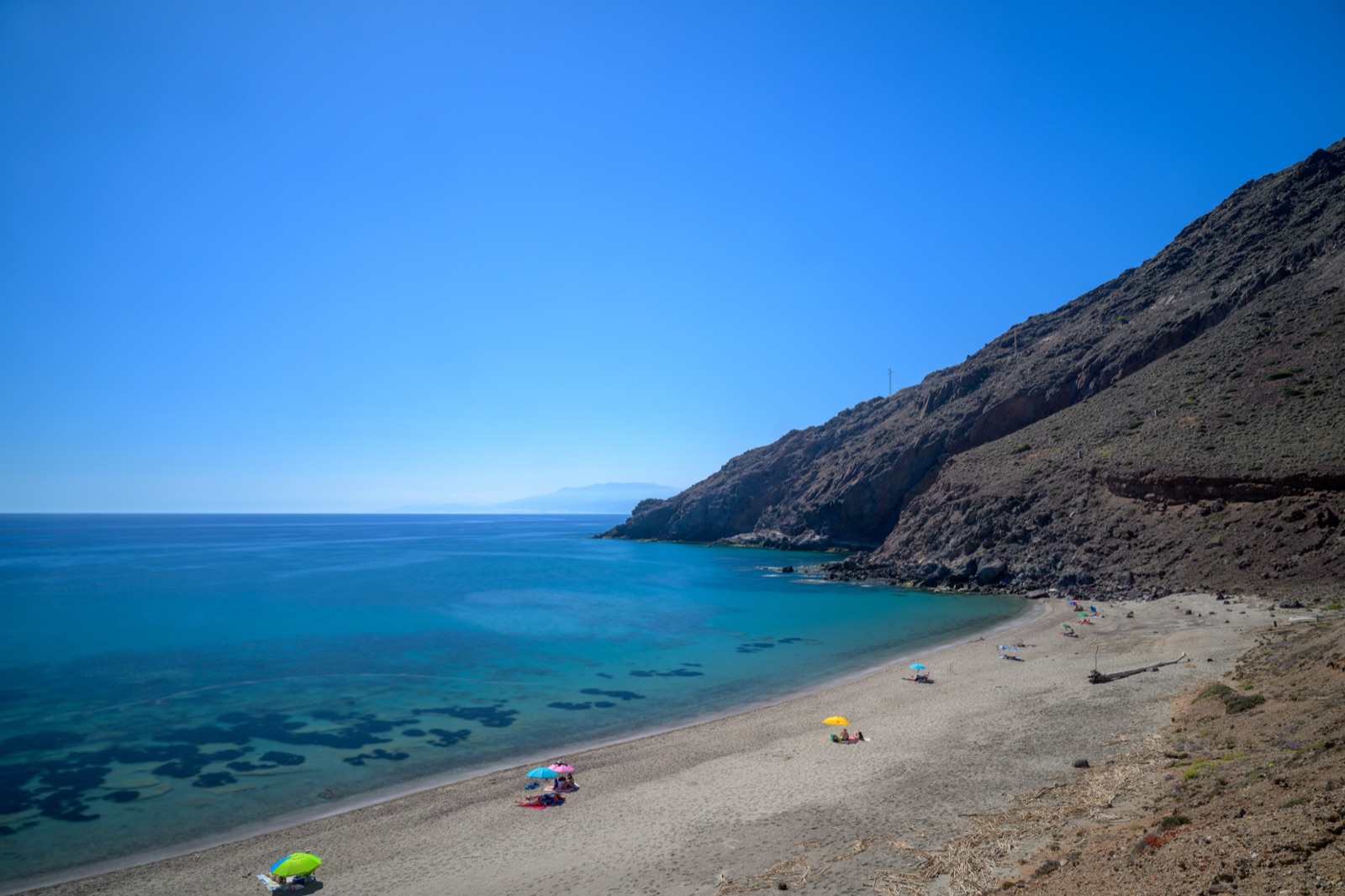
The Best Beaches and Coves of Cabo de Gata: Mónsul, Genoveses, Los Muertos and San Pedro
The beaches of Cabo de Gata are unlike anywhere else on Spain’s Mediterranean coast. There are no promenades, no high-rise hotels and, at the best of them, no bars or sunbeds. Instead there are wide bays of golden sand backed by dunes, black lava rocks rising out of turquoise water, and small coves at the foot of volcanic cliffs that you can reach only on foot or by boat.
This guide covers the beaches most worth your time — what makes each one special, how to get there, who it suits and what to watch out for — along with how to see the coves you cannot walk to from the sea.
Why these beaches are different
The secret is volcanic. Volcanic activity began about 16 million years ago and ended about 8 million years ago, and only 5 percent of the volcanic complex rises above the water; the other 95 percent lies below the sea. What remains on land shapes the shore: the volcanic Sierra del Cabo de Gata falls to the sea in jagged 100-metre cliffs, cut by gullies into small coves and beaches.
The other secret is protection. Its 63 km of cliffs form the best-preserved coastline of the Spanish Mediterranean, and the beaches have been kept largely as they were because the park has limited building and, at the most famous beaches, limits cars in summer.
Before you go
Bring everything
Most of the famous beaches have no services at all. There is nowhere to buy drinks at Mónsul; bring what you need, and Los Muertos lies between Agua Amarga and Carboneras, far from any village, and has no services. Pack water, food, shade and a bag for your rubbish.
Mind the access rules
In summer, motor-vehicle access to the beaches west of San José (Genoveses, Mónsul, Media Luna, Cala Carbón and others) is regulated: vehicles pay a single €6 fee, and the barrier closes at set hours or early when the car parks are full. A shuttle bus from San José drops you at the beach access points, and walking or cycling to the beaches is free. At Los Muertos, in summer the car park charges €6 for cars, and spaces are limited. See our guide to getting to Cabo de Gata for the details.
Watch the wind
The wind decides which beaches are pleasant on a given day. The levante, the east wind, is the one to watch: it brings waves to the east-facing beaches and can make swimming dangerous at the steeper ones.
Genoveses
The bay
Genoveses fills the whole bay, more than a kilometre long, backed by small dunes with prickly pears and agaves. It is the most natural-looking of the big beaches: a sweep of golden sand in an almost empty valley, with no buildings in sight.
Swimming
Its gentle, gradual entry into the water suits families, but strong winds can create dangerous rip currents. On calm days you can wade a long way out before the water covers you; on windy days, stay alert.
Getting there
Genoveses is no more than a kilometre from San José, and the unsurfaced track is easy, even with a pushchair. It is the easiest of the famous beaches to reach on foot. In summer, the shuttle from San José stops nearby too — from the Genoveses stop it is about a 10-minute walk.
History
The name has a story. The beach is named after a fleet of 200 Genoese ships that camped in the bay in 1147 before the attack on Almería by the forces of Alfonso VII. Four centuries later the bay sheltered an even greater fleet: in 1571 a Spanish fleet of more than 300 ships and 30,000 men gathered in the bay before the Battle of Lepanto.
Around the bay
- The Morrón de Genoveses. The Morrón de Genoveses hill closes the south of the bay and gives a view over the beach, the Campillo del Genovés and San José.
- The Posidonia. A vast Posidonia meadow lies offshore, and the seagrass often washes up on the shore. The piles of dried leaves on the sand are natural seagrass from those meadows, not litter.
- The trail. The Los Genoveses trail starts by a windmill restored in 2007 and passes Civil War bunkers on the beach.
Mónsul
The beach
Mónsul is the most photographed beach in the park, and the one where the volcanic origin of the coast is clearest. The rocks around Mónsul are tongues of lava that reached the sea and were eroded by wind and water; a huge rock stands in the middle of the beach. That rock, standing alone on the sand, gives welcome shade on hot days and is the image most people remember.
On film
Mónsul’s scenery has drawn film-makers. Steven Spielberg filmed scenes of Indiana Jones and the Last Crusade at Mónsul. Many visitors come simply to stand where the film was shot.
Getting there
Mónsul is reached by a 4-kilometre forest track from San José. In summer, the easiest way is the shuttle: the shuttle stops about 50 metres from Mónsul beach. If you drive outside the summer regulation, park in the designated car parks.
Beyond Mónsul
The track continues past Mónsul to smaller coves, Media Luna and Cala Carbón, which fall within the same summer regulation. At the end of the track, a barrier stops cars, and walking on past the barrier at the end of the track, you can climb the Vela Blanca hill for a view over the coves.
Los Muertos
The beach
In the north-east of the park, Los Muertos is a long, straight beach of fine gravel and exceptionally clear water, often named among the most beautiful in Spain. Los Muertos lies between Agua Amarga and Carboneras, far from any village, and has no services, which is part of its appeal.
Getting down
This beach has to be earned. Los Muertos beach is always reached on foot by a path; only the nearby car park is regulated. Three paths lead down: one from the information point, about 700 metres with a steep drop; one from the end of the car park, 100 metres shorter but much steeper; and old, uneven stone steps near the viewpoint. The descent is not easy and is not advisable for children, older people or anyone with reduced mobility.
Swimming safely
The shore shelves steeply, so you are soon out of your depth, and swimming is dangerous in a strong levante (east) wind. On calm days it is superb; on windy ones, stay out of the water.
Parking and transport
In summer the Los Muertos car park charges €6 for cars, €3 for mopeds, €4 for motorbikes and €10 for vans, motorhomes and buses, from 09:00 to 21:00; spaces are limited. From early July a shuttle bus runs from Carboneras town to Los Muertos. Boats cannot drop you off: current rules prohibit landing boat passengers directly on Los Muertos beach.
Cala San Pedro
The cove
Cala San Pedro feels like a secret valley. The beach is 250 metres of fine white sand with a gradual entry into the water. The white sand turns the sea a vivid turquoise. Behind the beach, the valley is unusually green for this dry coast, because Cala San Pedro has a natural freshwater spring and a small community that lives there all year.
Getting there
- By boat. Boats from Las Negras beach reach Cala San Pedro in 10 to 15 minutes. This is the easiest and most popular way.
- On foot. On foot, the path starts from Las Negras; even from the San Pedro car park it is still about 2 km along a narrow path near cliffs. Wear proper shoes and carry water.
Because it can only be reached this way, San Pedro keeps a sense of remoteness even in summer.
The Mermaid Reef cove
At the southern tip of the park, below the lighthouse, is one of its most famous views and one of its smallest beaches. The reef’s rocks are old volcanic chimneys, dark from the material they erupted, rising from clear water. A short path leads down to a tiny cove with room for barely 4 or 5 towels at low tide. The waters around the reef are a favourite with divers, and the snorkelling from the rocks is excellent on calm days.
The name comes from an old confusion: the Mermaid Reef is probably named after the monk seals that once lived here, which old sailors could mistake for mermaids; there are none today.
Seeing the coves from the sea
Many of the best coves have no path at all, and the cliffs look their most dramatic from the water. A boat, a kayak or a sailboat is the only way to see them.
Kayak and snorkel tour. Paddle along the volcanic cliffs to coves reached only from the sea, then snorkel with a full-face mask. Snorkel gear included, and a drink at the end is included. About 3 hours.
Six-coves boat route from Carboneras. Two hours in a small boat (11 passengers at most) past coves, volcanic cliffs and sea caves, with a swim and snorkel stop; mask included, and a refund if the sea is too rough.
Boat trip from San José. A guided cruise from San José past untouched coves, old volcanoes and the ruins of watchtowers and castles. About 1h 45m.
Sailing to Los Muertos beach. A family-friendly sailboat from Carboneras to Los Muertos beach and Agua Amarga, with a snorkelling stop in a cove. About 3 hours.
The tours page lists them all with live prices.
Which beach for whom?
- Families with small children: Genoveses, for its gentle, gradual entry and the easy walk from San José. Cala San Pedro also has a gradual entry, if you arrive by boat.
- Photographers: Mónsul, for the lava rocks and the lone rock on the sand, and the Mermaid Reef viewpoint by the lighthouse.
- The adventurous: Los Muertos and Cala San Pedro, which reward the effort of the walk.
- Snorkellers: the rocky edges of the coves and the Mermaid Reef, where in just a metre of water you can see several fish species; the richest marine life is at 5 to 10 metres.
- Walkers: the Genoveses trail and the climb to Vela Blanca beyond Mónsul.
A beach-hopping day
- Early morning: walk from San José to Genoveses while it is quiet and the light is soft.
- Late morning: the shuttle to Mónsul for a swim in the shade of the great rock.
- Afternoon: on foot past the barrier to climb Vela Blanca for the view over the coves, then back by shuttle.
- Evening: drive or ride to the lighthouse for sunset over the Mermaid Reef.
On another day, head north-east for Los Muertos in the morning and Cala San Pedro by boat from Las Negras in the afternoon.
The beaches through the year
- July and August are the busiest months. The car parks fill early, the barrier on the San José track closes when they are full, and the shuttle is the easiest way in. Go early or late in the day for space on the sand.
- June and September are the sweet spot for many visitors: the sea is warm and the crowds thinner, though the summer rules may still apply, so check the year’s dates.
- Spring and autumn bring free access: outside the summer regulation, access is free, but you must always park in the designated car parks. In October the mean maximum is still 24.1 °C, warm enough for the beach on calm days.
- Winter is for walking the coast rather than swimming, with the beaches almost to yourself. Mean daily maximums run from 16.8 °C in January.
What to pack
- Water, and plenty of it. None of the wild beaches sells any.
- Shade. A parasol or sunshade; natural shade is scarce, except under Mónsul’s great rock.
- Food for the day, or a plan to eat in San José, Las Negras or Carboneras.
- Proper footwear for the paths at Los Muertos, San Pedro and the Mermaid Reef.
- Snorkel and mask for the rocky edges and the reef.
- Binoculars if you will pass the salt flats.
- A bag for rubbish, to carry everything home.
The rules that keep them wild
A few rules protect the beaches, and knowing them avoids surprises. A height barrier keeps caravans and motorhomes out at night, from 20:00 to 08:00; camping is prohibited. The €6 fee pays for access control, environmental information, cleaning beaches and tracks, portable toilets and watering the track, so the charge goes straight back into the beaches you are visiting. At Los Muertos, boats may not land passengers on the sand.
Safety
- Respect the wind. Strong east winds make Los Muertos dangerous and can raise rip currents at Genoveses.
- Mind the shelves. At Los Muertos, the water is out of your depth a few steps from the shore.
- Take the heat seriously. The walks down to Los Muertos and out to San Pedro are short but steep or rough, and there is little shade.
- Carry water. None of the wild beaches sells it.
Protecting the beaches
These beaches stay beautiful because they are protected and because visitors treat them well. Spearfishing is completely prohibited, camping is not allowed, and the Posidonia on the sand should be left where it lies. Take all your rubbish home, keep to the paths on the dunes, and never drive off the tracks.
Frequently asked questions
What is the most beautiful beach in Cabo de Gata?
It depends on taste. Mónsul is the most photographed, for its lava rocks; Genoveses is the most natural, a kilometre-long bay of golden sand; Los Muertos has the clearest water; Cala San Pedro is the most remote.
Which beach is best for children?
Genoveses: its gentle, gradual entry suits families, and it is no more than a kilometre from San José on an easy track. Los Muertos is not advisable for children.
Where was Indiana Jones filmed in Cabo de Gata?
At Mónsul. Steven Spielberg filmed scenes of Indiana Jones and the Last Crusade on the beach.
How do you get to Cala San Pedro?
By boat from Las Negras beach, 10 to 15 minutes, or on foot along a narrow path near cliffs.
Are there bars at the beaches?
Not at the wild beaches. There is nowhere to buy drinks at Mónsul, and Los Muertos has no services, so bring everything you need.